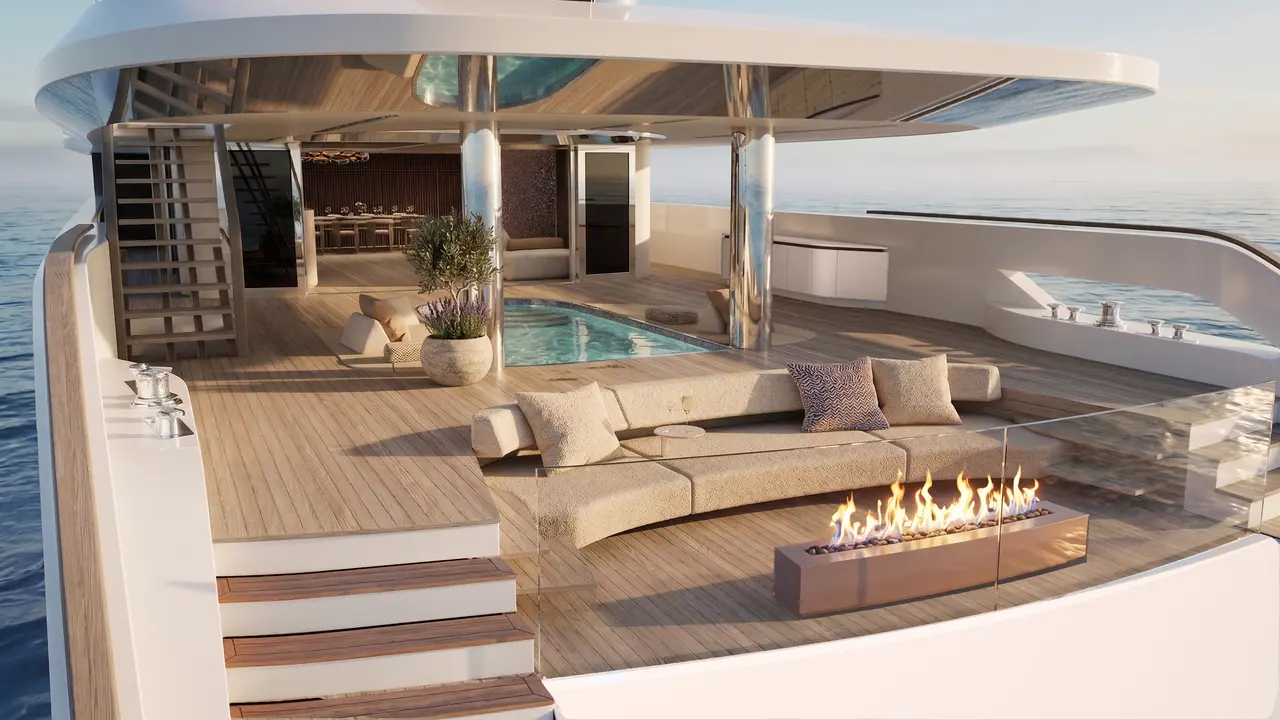
47 m Catamaran
A catamaran with no CO₂ at the exhaust, designed for 2050.
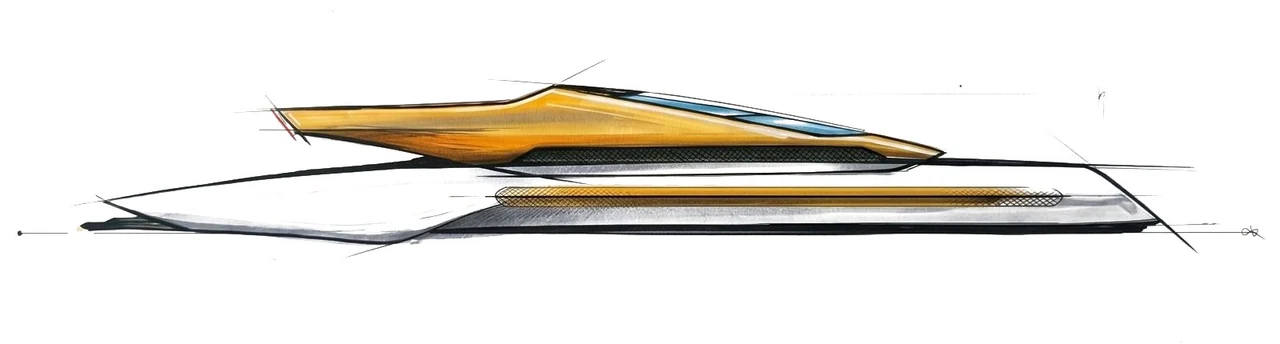
Concept sketch: Gianluca Losa
Design
- Geremia Anghinetti
- Ennio Tito Gagliasso
- Gianluca Losa
Engineering
- Stefano Ghisolfo
- Francesco Giacobone
- Tommaso Boiani
- Type
- HYSWAS catamaran
- Length
- 47 m
- Tonnage
- < 500 GT
- Designed for
- 2050
The concept
The brief asks for a yacht designed for 2050. Our answer is a 47-metre catamaran that sails around the world following the great regattas — kept under 500 GT, lifted on submerged hulls and powered by ammonia, with no CO₂ at the exhaust.
Around the world at regatta pace
The boat follows Magellan’s route, with detours timed to reach the great regattas while they are raced. Guests can book a single leg or the whole loop.
- 01Transat Jacques VabreLe Havre · Martinique
- 02Route du RhumSaint-Malo · Guadeloupe
- 03ARCGran Canaria · Saint Lucia
- 04Strait of MagellanThe historic route
- 05TranspacLos Angeles · Honolulu
- 06The Ocean RaceRound the world in legs
- 01
Under way
With guests on board the boat stays private: sailing, following the races, cultural stops.
- 02
Seasonal stop
The seasons of the trade winds force long waits before some crossings. The boat stays moored where the races are.
- 03
Brand hospitality
During those stops it becomes a lounge for brands at start and finish villages — one calendar, two uses.
Technology from other worlds
The research looks at what the military, racing and automotive industries are developing today, and brings it into cruising — anticipating where the market is heading.
-
From the military
HYSWAS
Hydrofoil Small Waterplane Area Ship: a US Navy concept from the 1970s. The hulls ride above the surface and only a submerged torpedo works in the water, joined by slender struts — less wetted surface, less wave, more stability and seakeeping.
-
From racing
Wing sails
Rigid, automated wings descended from the America’s Cup: they push the boat on the trade-wind legs while the propellers regenerate energy.
-
From automotive
AI routing
The route follows wind corridors rather than the shortest line: an AI weather router reads pressure, currents and sea state for constant micro-adjustments. Support, not delegation.
−60% watch hours (estimate)
Ammonia to propeller
The torpedoes, 1.65 m in diameter, carry the ammonia tanks and the motors; above them, in the hulls, sit the solid-oxide fuel cells (SOFC) and the batteries. Ammonia feeds the cells, the cells drive electric motors. No CO₂ at the exhaust.
- range at 12 knots
- ~3,000 nm
- range at 22 knots
- 1,700 nm
- ammonia on board
- 50 t
- net fuel-cell power
- 2.1 MW
- 01Liquid ammonia
- 02Evaporator + cracker
- 03SOFC · 1,050 kW per side
- 041,000 V DC bus + 160 kWh batteries
- 05933 kW motor · contra-rotating propellers
How far it goes
- 12 kn 2,934 nm ·244.5 h
- 14 kn 2,719 nm ·194.2 h
- 16 kn 2,384 nm ·149.0 h
- 18 kn 1,970 nm ·109.4 h
- 22 kn 1,697 nm ·77.1 h
- 24 kn 1,519 nm ·63.3 h